Thursday, March 18, 2010

Printing Composition - Campaigns


I went down to the elementary and couldn't have been given a better opportunity for a picture. This woman has voluntarily decided to help these two children learn their abc's. The little boy in the picture was so excited to learn his abc's he did it all by himself.


This photo was also taken when I went to visit the elementary kids, I really like the idea of this one, each kid was given a piece of the puzzle and they worked together to create the finished product which is what I was able to en capture.


This was my favorite idea personally. I chose something that didn't involve school or a classroom. It was something that every kid learns and is helped by their parents. I think that the composition could have been better but i still like the concept of this photo. Different and hopefully catches peoples attention.

Image Bank

Abbie Trayler-Smith

Abbie Trayler-Smith was born and raised in South Wales in 1977. Her interest in photography began while she was at school for law at kings college in london. She was a self- taught photographer who began with shooting people for the school newspaper. After graduating in 1998 she began working at the Daily Telegraph and then was signed with a full contract in 2001. Nine years into her career she had worked photographing war ridden countries and countries that had faced disasters. In 2006 she resigned from the Daily Telegraph to work on a wider variety of projects.


This photo is from one of Abbie's projects- Mali. All of her photos are like this, they are set in underdeveloped areas or places that have faced a tragedy. This one seemed a little different than the others and that is why I chose this one out of her many different exhibitions.


This photo is for a clothing spring- summer clothing campaign. I chose this photo because it is nothing like any of the other ad photos. Although it does follow the same "guidelines" to be an ad. Most ads have something that is completely out of the ordinary, there is something in the photo that catches the viewers attention. This photo caught my attention just because of the way that the woman in it is posing. It is clearly not a regular pose and does not have anything flashy so the pose is what makes the photo work.


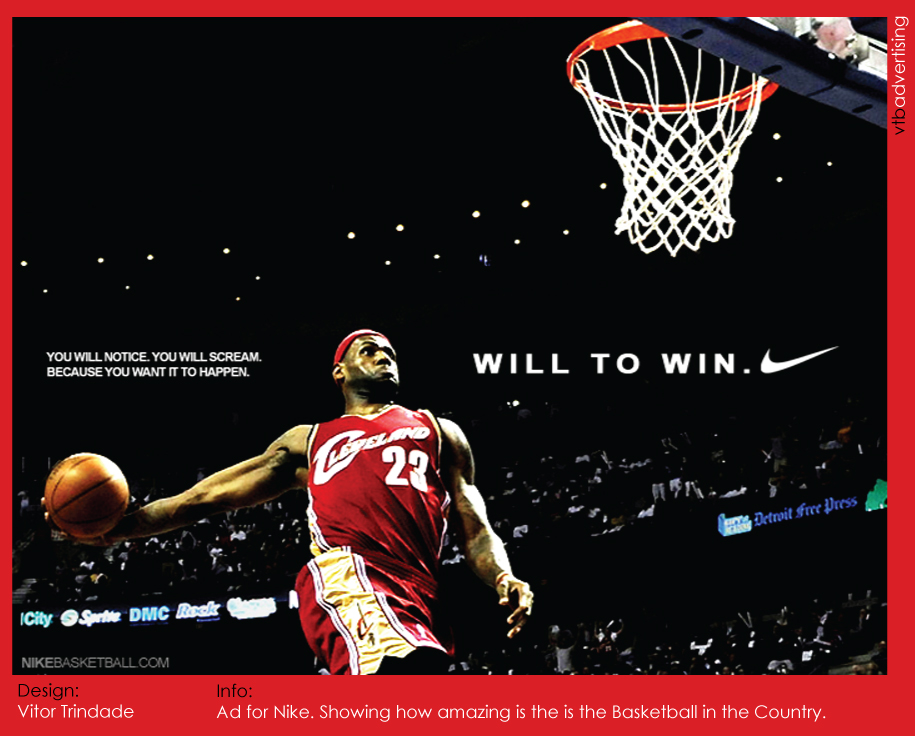
Many nike ads are advertising shoes. This photo advertises more than that, the clothing, the game, and the player. Sports use different techniques than clothing companies. They use the athletes and get them at their best to sell their product. The catch the player in one of the most intense times of their game and they add quotes and their slogans. Those slogans catch on and that is how these ads get successful.


This ad is a campaign for shoes. At a first glance that is not what someone would think. And again in the clothing business there has to be something to catch the viewers attention and the fact that the girl is wrapped in nothing but vines really makes someone take a second look and then realize that it is for shoes.

Wednesday, February 17, 2010

Advertisements

Advertising campaigns

An advertisement campaign is a series of advertising messages that all show similar ideas to get the product popular. These messages are all shown around the same time frame and there are many ads for each company.


Levi "Go Forth Campaign"


This advertisements show the different varieties of styles that the jeans company has. They can provide for everyone with all the different varieties. In their new ads campaign they don't use any famous people but in some of their previous campaigns they have used some famous people such as actors. Actors such as Brad Pitt have been used for past commercials. And the past campaign was Unleash your beast.


Toyota


Toyota is the world's largest automobile maker, located in Japan. Its largest sales are in the United States. The company has been around since 1937. At the beginning of the 80's Toyota won the first Japanese Quality Control Award. A few years later they made a deal with GM(General Motors) in the United States to have a manufacturing plant in Fremont, California. With this expansion to the United States, they began producing their luxury branch. Lexus and Scion are the other Toyota produced automobiles.

Beginning in the 1990's Toyota began to expand their vehicle production and began making SUVs, pickup trucks and sport versions of their older models. The Camry is one of the older models that had a sports version made. The Solara along with the camry were more affordable yet still sporty. Most recently toyota had made the best selling hybrid, the Prius. Its production began in 1997 and has grown with its modifications since then.

A few years ago Toyota had joined with citroen and began producing models for formula one racing.

At the beginning of this year Toyota has had to recall up to 1.8 million cars just across Europe.
This recall is said that it could cost up to 2 billion dollars.


Toyota is the world's largest automobile maker and had won at one point the Quality Control Award but now, making more luxurious cars, they have had problems and are hurting themselves.


Unicef


Unicef, also known as United Nations Children's Fund was created on December 11, 1946 by the UN General Assembly. The group was originally organized to provide emergency help for children during WWII.
Unicef became part of the United Nations System in 1953. The name was shorted after they had become a part of the UN system from the original United Nations International Children's Emergency Fund but still uses the acronym to this day. Now Unicef provides humanitarian and development assistance to children and mothers who need it. Unicef main contributors are governments and private donors. Unicef has been awarded the Nobel Peace Prize in 1965 and the Prince of Asturias Award of Concord in 2006.
Unicef's fundraisers and advertisements include, "Trick-or-Treat for Unicef," their sponsorships with sports teams, and Art in all of us.

The "trick-or-treat for Unicef," is where children collect money fro unicef on halloween night rather than collecting candy. This is present in the United States, Canada, and some other countries.

Its sponsorships with sport teams include, the football club, FC Barcelona, Team Canada in the grand prix, Swedish Club Hammarby IF, NASCAR drivers, Renault Formula One team.

Of these sponsorshps, Barcelona has made a deal to donate 5 million euros per year for 5 years and will wear the Unicef logo on their jersey's.

Ever since 1950 a group of kids donated 17 dollars on Halloween night in Philadelphia and since then they have made this a tradition and has collected a total of 91 million canadian dollars in Canada and 132 million dollars in the US.


Friday, February 5, 2010

Diary Entry- Traditional Regalia

This project really didn't seem any different than any other that we have done. The only different thing was that not everyone was taking pictures at the same time, which made things a lot easier and more relaxed. I only have one print at the moment and it took about two minutes to get the photo and it came out ok. The lighting was just a little dark so I used the levels to change the bright light for the background. The other pictures I can do from home and see the final image at home which is much easier for me to do a project. Digital projects seem to go a lot quicker.

Monday, February 1, 2010

Printing Composition - Traditional Regalia


The usual lumberjack from Canada is easily portrayed with a red flannel shirt and a nice fur hat. By standing by a tree I was really able to capture the true lumberjack in Javier. The pose in most of the lumberjack pictures people usually see are not very consistent expect for the fact that most of them are holding an axe as well.

I had two pictures of Javier that are very similar but i decided to use this one because the light in from the back in the other picture was too bright. And also the fact that the little strap off of hat was hanging off the side bugged me a little bit. Using photoshop I was able to make the picture a little darker which brought out more of the color in the shirt of the picture. The hard light in the background is the only thing that is bothering me and creating a problem that is a little hard to work with.


This is the print that I decided to use to represent the american hippie culture. To portray hippies, peace signs, tie dye shirts and headbands were used. The print has some light coming from both sides, the light makes the print different than other portraits.

I adjusted the photo by changing the levels, making the picture a little brighter and got rid of some unnecessary shadows.


This photo represents the more "stereotypical" mexicans with the button up shirt, sombraro, and guitar. The use of all of these factors does portray the culture. The photo doesn't have much lighting or a pose, just a smile and a guitar.


I made several changes to this photo, I made it that there was a blank wall behind the subject rather than a door handle and poster on the side. I changed the levels in this photo as well and I liked how making a little darker made it more catchy for my eye.

Tuesday, January 26, 2010

Image Bank- Traditional Regalia


I chose this photo of a soldier standing in front of the American flag because it is probably the most common kind of formal picture in the US nowadays with the amount of people joining the army. Everyone must get their portrait taken in uniform, in front of the flag, without smiling. There is not one special photographer and the photographer is most likely not a professional. It is a very basic kind of photo but becoming more popular as times of war rise.


When thinking about traditional clothing I could think of military and being in formal uniforms and while I was searching I found this picture. Its of an eskimo family and they are wearing their big fur coats as we always see eskimos. This made me think that this is their formal and only clothing they have. This is a good example for traditional regalia, although this is the clothes we always see them with it is still considered their traditional wear.


This photo is of a geisha in Japan. I chose this photo because I saw it and noticed how much make up the girl is wearing and it just seemed weird that she had so much on. The girl is in her full dress, full make up and holding an umbrella. This is how geishas are portrayed, in their full dress and a lot of make up.

The photographer who took this is Frantisek Staud, He is a traveling photographer that doesn't specify in certain things while taking pictures. He ranges from people to landscape and buildings.


William Hogarth is a English painter who focused on painting people in their very formal clothing. Here is a picture of a group of people sitting around a table all dressed with what looks like a chef and a butler who too are dressed pretty decently.


This photo was taken by Annie Leibovitz, her style of photography is mostly for magazine covers and are of famous people. In her pictures she works with poses and costume to make the picture more powerful. She can really capture the person in her photo because her work is based on a close collaboration between herself and the subject.

Theory Notes- Traditional Regalia


This photo is a good example of a formal pose of the monarchy. The queen is placed in front of the golden and white doors suggesting the royalty she live in. She is wearing her crown and sash which are typical forms of regalia for this culture. The badges and medals on her sash are rewards for something. This shows that she has earned something and it is another thing for her to be proud of and support along with the crown.

In most formal pictures of the monarchy, they do not usually smile and this may be because they need to show their true belief in their country. To be devoted to a country and support it to its fullest, in some ways is presented by wearing things like a crown or sash. The white gloves suggest royalty or wealthiness not the status of the person.


In this photo we can see some members of the United States Marine Corps. They are all standing the same way, they are all wearing the same uniform and holding their weapons in the same way. This is a very formal pose, the weapons are not being used for what they are made for. In this case they are a prop. In the marine corps you must be very disciplined and must be is sync with everyone and every point in time if you are marching or just standing.

The regalia of these marines is their uniforms, their guns, their hats, their badges, which are the only things that may be different between all of them because they need to earn the badges. Everything is the same between them.

The pose in a picture is very important because depending on how or where you are standing in the frame you can easily be displayed as more important than someone else.

Tuesday, December 8, 2009

Image bank- recreating film stills


I chose this picture taken by Elliott Marks from the film, Starsky and Hutch because it is pretty similar to the one I have that has three people in it. Not only does it have three people but it also is the discipline to one person from a higher power and the third person is just in the picture listening in to what is going on. The picture of mine in which this relates to is the one of Fabrizio, Barbara, and Meghan. The difference between the pictures is that everyone is standing in this one as in mine everyone except the person is sitting.

Elliott Marks, one of Hollywood's most respected film photographers worked on many movies. His first movie that he worked on was in 1971 and it was Chrome and Hot leather. He was thirty when he worked on his first movie. He worked on some big name movies like Pirates of the Caribbean and his last movie he worked on Starsky and Hutch.


This shot is from the film, In love and War. I chose this picture because it represent the picture I have of Fabrizio holding a bottle in his hand. Both pictures of someone staring off into a daze. The only difference of the pictures is that the man in this picture is not holding anything to look at he is just gazing off into the distance.

The film photographer for this movie is Yousuf Karsh. He worked with this film in 1997 and it was one of his only films he worked with. He is a famous film photographer who survived an Armenian Genocide by the Ottoman Empire and came to Canada when he was 16 years old to live.

This shot is from one of the many films done by David Nowell. This shot has been taken from the film tropic thunder. I chose it because it shows one man very interested in something. This is similar to my last photo, the one of Fabrizio smelling the object. Both characters are very interested. The differences are that the man in this picture is not holding anything but we can tell he is focused on something, looking away from the man behind him and using his hands to signify some are the things that can tell us that he is focused on something.

David Nowell has been the director of photography for 137 films. The first one being in 1974 and now working on 7 more for 2010. He has been the film photographer for a lot of major motion pictures like Transformer, Tropic Thunder, Star Trek, Iron Man and many more. He mainly works with action movies.


I chose this photo done by Mirjana Vrabaski because this was the one that stood out to me. It was very different than all the others. All of the other pictures have people either just sitting and standing. The one has a repeated layer and the body is moved to the right a little with a face other than neutral like the other pictures.

I liked how she worked where she would take someone and worked with them trying to get the picture that she wanted. She wouldn't necessarily find the right person right away and this requires a lot of patience, to go through many trials until you find what you want.


Monday, November 30, 2009

Printing Composition- Re-creating film stills


Contact sheet- ap- 8, time- 8 sec
All of my shots seemed to have similar contrast in the contact sheet but I learned later that they all needed different settings.


ap- 8, f- 2, time 16 seconds

This print took a couple of tries to finally get, I had to mess around with the aperture and filter.


This photo didn't require much lighting, just room lights and a back light to serve as a wall light, the prop was just to replace whatever the guy in the original is holding. I chose fabrizio for this photo because he gives the best facial expressions and I needed an expression I could only see Fabrizio doing.


ap- 16, time 30 secs

This print also took a few tries because I also tried combinations of settings, these settings turned out the best.


This setup is as close as I could get to re-create the original picture. I just don't have a desk that they are sitting at but I was still able to show that there is someone in the picture(meghan) who is just listening to what the person standing is yelling(fabrizio) and the final person(Barbara) is sitting there as if nothing much is going on. The lighting for my pictures were all pretty easy, mainly just room lighting and that is what I have achieved.


ap- 8, time- 12 secs

There was a problem I had with this print, and that was no matter how much time I used or what the aperture was, I would always end up with one of the eyes blacked out, so this is what the print was like with 12 seconds, 14 was way too dark.


Like I said about my picture had very simply lighting and in this picture all I needed was a softbox in the back to work as the wall light in the original photo. The prop was the las thing on my mind to get close to the original. They are pretty close though, in the original the man is holding a cup and in my re- creation, fabrizio has a water bottle.

Thursday, November 19, 2009

Theory nots- re-creating films stills


This film still is similar to the one of Meghan, Fabrizio, and Barbara. They are similar because they both have someone that is sitting listening to everything that the one person is yelling. The one sitting in this one is compared to Meghan in the other picture. Fabrizio is compared to the guy on the left with the grey hair who is yelling, or dictating, and Barbara is the last person who really is just there to be there, they aren't a very big part of the picture just an extra person almost.


This photo was taken from the film, "M" it was a film noir and the film photographers took many dark photos, hence the name film noir. This picture relates to the one I have of Fabrizio staring at the bottle because first of all the obvious positioning is the same, they are looking the same way and the lighting is similar. The light is coming from the right side of the photo which is the left side of the man's face. The limitations that they had back in the 1940's is that their lighting was not as sophisticated as what we have now but the low lighting causes a morbid mood, as in my photo the mood is not morbid, the person in my print is studying and focusing on something.


This photo was taken from the film The American Nightmare. This picture relates to the last one of mine where Fabrizio is smelling the object. The obvious ways that they are similar is their positioning, their bodies are facing relatively the same way, and they are looking the same way. The differences is that the woman in this picture is not as focused on what she is looking at as Fabrizio is with smelling the thing in his hand. The lighting is pretty similar but that is because the lighting in my photo was nothing really but room lighting except for the wall light coming from the reflection in the mirror. In the 1960's there weren't many limitations for what photographers could do with their photo's except to digitally enhance them to the extent that we can.

Diary entry- re-creating film stills

This is the first time being in the darkroom after quite a long time, we just got back from break but I was able to jump right into working well in the darkroom. I was able to get a contact sheet pretty quick and started working on my prints the first day. I have been working well in the dark room, I can chose my starting times but I need to work on judging my pictures better, I think that I will do the wrong thing so I need to just try what I think and learn from there what I need to do to improve.

Thursday, October 8, 2009

Photo Project layout


This is the layout of my project. The main topic cultures, then branching out to the different subjects.

Tuesday, October 6, 2009

Cultures- Fashion- trends

contact sheet ap- 4 time- 16

David(scooter helmet)- ap 5.6 time- 16
Dutch Culture

Fabrizio(Baggy and colorful)- ap 4 time- 16
American Culture

The trends of fashion between the two cultures are kind of similar to certain extents. Here I chose more of the extremes, where you wouldn't see an American person wearing a helmet, pretty much at anytime. And as for a dutch person, its not that likely that you see everyone wearing bright, vibrant colors.

Contact sheet- ap 4 - 16

Bikes- ap- 4 time- 16
Dutch culture

Big SUV- ap- 4 time- 16
American Culture

These two very different means of transportation show both the American way of getting around and Dutch way. The dutch tend to ride bikes more than drive cars and this bike can clearly show how unique it is and most likely wont be seen in the U.S. As for the americans who drive more SUVS per one person rather than smaller cars, by looking at what the Americans use as their transportation we can see that they like their space.


Culture project

My main topic for this year is to focus on cultures. Two in particular, the dutch and the american culture. I have many focuses that branch out from cultures. These topics are; the people, the fashion, customs, and living areas. For each section I will give examples from each culture that show the difference or in some ways the similarities of the two cultures.

Cultures- People


First contact sheet- ap-4 time- 26 seconds


Sierra- ap-4 time- 26
American culture
Heather- ap- 4 time - 26
American Culture

Meghan- ap- 4 time- 26
American Culture

Javier- ap-4 time-26
Dutch culture

Contact sheet- ap-4 time-32

Jordan- ap- 4 time- 32
American Culture

Raul- ap- 4 time- 32
Dutch culture

Friso- ap- 4 time- 32
Dutch Culture


From these comparisons you can not see that we the two cultures are relatively similar in appearance when looking at the people. In this section of the project, there is more comparison rather than looking at the differences.